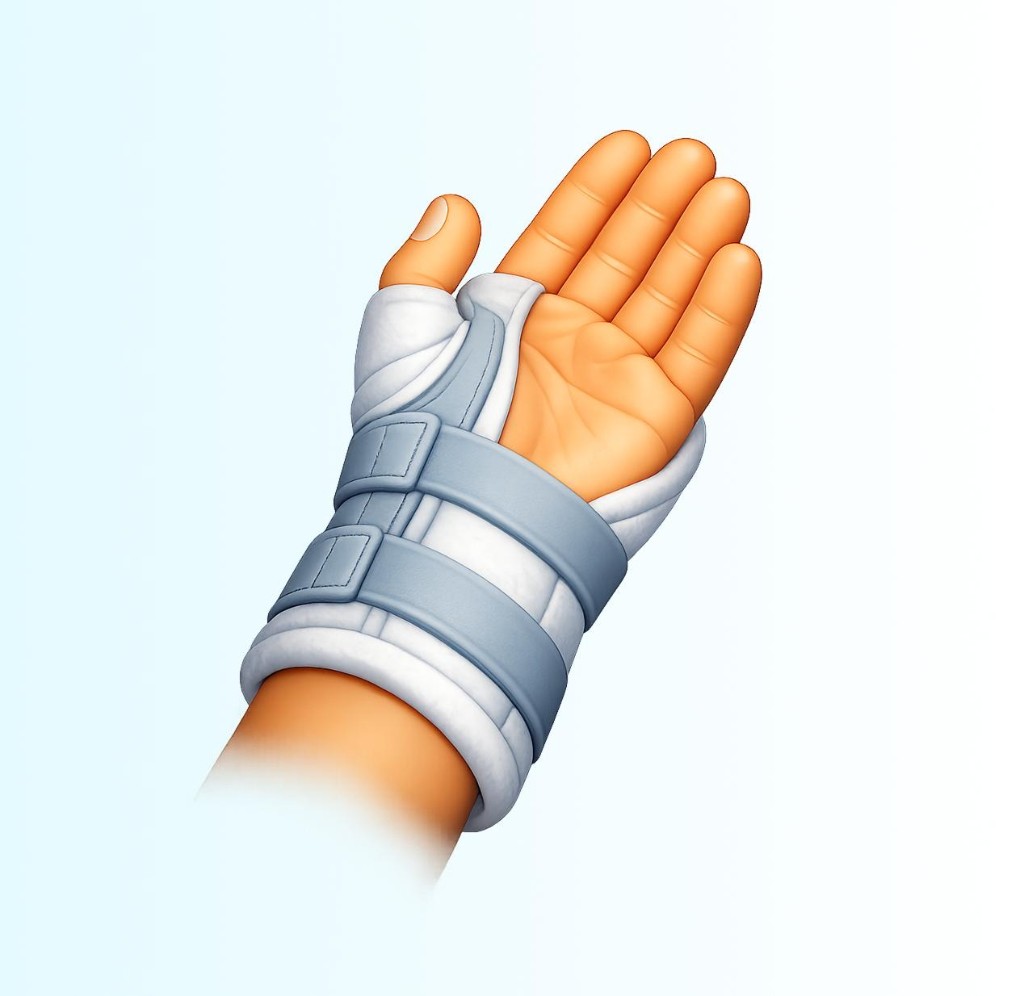
Carpal tunnel syndrome
Pressure on the median nerve at the wrist that often causes numbness, tingling, and night-time symptoms in the thumb, index, and middle fingers.
Common triggers
- Sustained wrist flexion (e.g., curled wrist while sleeping)
- Long sessions of typing or tool use
- Pregnancy, thyroid changes, or other systemic factors
When to seek care
- Numbness that wakes you at night
- Weakness or thumb muscle wasting
- Symptoms that progress despite splinting and ergonomic changes
Splints often used: Wrist cock-up splint Trigger finger
A finger or thumb that catches or locks when you bend it, often with a tender lump at the base of the finger. The tendon catches as it slides through its sheath.
Common triggers
- Repetitive forceful gripping
- Diabetes or rheumatoid arthritis
- Postmenopausal hormonal changes
When to seek care
- Locking that needs the other hand to release the finger
- Pain that limits daily tasks
- Symptoms that persist after splinting and rest
Splints often used: Buddy straps De Quervain's tenosynovitis
Painful swelling of two thumb-side wrist tendons, especially with lifting babies, pouring jugs, or wringing. The tendons are pinched as they pass through their sheath at the wrist.
Common triggers
- Repetitive thumb extension and abduction
- Postpartum hand-use patterns
- Pinch-heavy work and hobbies
When to seek care
- Pain that limits picking things up
- Symptoms that don't settle with splinting and rest
- Swelling, locking, or weakness
Splints often used: Thumb spica splint Thumb base arthritis
Wear at the saddle joint at the base of the thumb (the carpometacarpal or CMC joint). Pain with pinching, opening jars, and turning keys is common.
Common triggers
- Years of pinch-heavy tasks
- Family history; more common with age
When to seek care
- Pain that limits self-care or work
- Visible deformity at the base of the thumb
- Grip weakness that doesn't recover with rest
Splints often used: Thumb spica splint Scaphoid fracture
A break in a small wrist bone (scaphoid) often caused by a fall onto an outstretched hand. It can be missed on early X-rays and may need re-imaging.
Common triggers
- Falls onto an outstretched hand
- Sports impact
When to seek care
- Wrist pain after a fall, especially at the base of the thumb
- Pain that doesn't settle in a few days
- Tenderness deep in the 'snuffbox' on the thumb side
Splints often used: Thumb spica splint Mallet finger
A fingertip that can't fully straighten on its own after a sudden bending force injures the extensor tendon at the end joint (the DIP joint).
Common triggers
- Jamming a finger
- Catching a ball with a fingertip
- Tucking in bedsheets and snagging a fingertip
When to seek care
- Inability to lift the fingertip on its own
- Bruising or pain at the back of the fingertip
- An open cut over the joint after injury
Splints often used: Mallet finger splint Dupuytren's disease
A slow thickening of the tissue layer (fascia) under the skin of the palm. Cords can pull one or more fingers in toward the palm over time, making it hard to straighten them fully.
Common triggers
- Family history (more common in people of Northern European ancestry)
- Older adults, more common in men
- Diabetes and some other systemic factors
When to seek care
- Fingers that won't lay flat on a table (a 'tabletop' test)
- A cord or nodule in the palm that limits hand function
- Worsening contracture interfering with daily tasks
Ganglion cyst
The most common lump in the hand. A fluid-filled cyst that often appears on the back of the wrist. It can change size, may be painless, and is not cancer.
Common triggers
- Joint or tendon-sheath irritation
- More common in women between 15 and 40
- Sometimes follows minor wrist trauma
When to seek care
- Pain or numbness from the cyst
- Rapid changes in size
- Cyst that interferes with hand function or appearance
Boutonnière deformity
An injury to the tendon that straightens the middle joint of a finger (the PIP joint). The middle joint stays bent while the fingertip bends back. Early treatment matters — it can become permanent if missed.
Common triggers
- Forceful bending of a straight finger
- Cuts or dislocations at the middle finger joint
- Inflammation from rheumatoid arthritis
When to seek care
- Inability to straighten the middle finger joint after injury
- A finger that is locked in a bent position with the tip flexed back
- Pain, swelling, or open wound at the middle joint
Splints often used: Buddy straps Cubital tunnel syndrome
Pressure on the ulnar nerve at the inside of the elbow causing numbness or tingling in the ring and little fingers, sometimes with hand weakness.
Common triggers
- Sleeping with the elbow bent for long periods
- Leaning on the elbow at a desk
- Repetitive elbow flexion at work
When to seek care
- Numbness in the ring and little fingers that wakes you at night
- Weakness with pinch or grip
- Trouble crossing your fingers or splaying them apart
Rheumatoid arthritis (hand)
An autoimmune condition in which the body attacks the lining of joints. In the hand it most often affects the knuckles and middle finger joints, with morning stiffness, swelling, and symmetric symptoms in both hands.
Common triggers
- Disease flares — not caused by activity but worsened by overuse
- Stress, infection, or missed medication doses
- Cold weather and inactivity
When to seek care
- More than 30 minutes of morning stiffness
- New joint swelling, warmth, or deformity
- Symptoms in the same joints on both hands
Splints often used: Wrist cock-up splint Finger osteoarthritis
Wear of the small finger joints, especially the end (DIP) joints. Bony bumps called Heberden's nodes can form. Stiffness, occasional aching, and reduced pinch are common, especially in the morning.
Common triggers
- Family history; more common in women after menopause
- Years of pinch- or grip-heavy use
- Previous finger trauma
When to seek care
- Pain that limits self-care or work
- Sudden swelling or warmth (possible flare or other diagnosis)
- Visible new deformity
Splints often used: Buddy straps Tennis elbow
Pain on the outside of the elbow from irritation of the wrist extensor tendons. Common with gripping, lifting, and twisting tasks — not just tennis.
Common triggers
- Sustained gripping with the wrist extended
- New or unaccustomed lifting or tool use
- Repetitive backhand or shoveling motions
When to seek care
- Pain that limits everyday gripping or carrying
- Symptoms that don't settle in 6–8 weeks of self-care
- Numbness, weakness, or sudden loss of function
Fingertip injury
Crushes, cuts, or pinches at the end of a finger. Can involve the skin, nail, nail bed, bone (distal phalanx), or the tendon that lifts the fingertip.
Common triggers
- Doors, drawers, and toolbox lids
- Sports impacts and falls
- Workplace machinery
When to seek care
- Bleeding that won't stop with 10 minutes of pressure
- Cannot bend or straighten the fingertip
- Exposed bone, nail bed disruption, or signs of infection
Splints often used: Fingertip protector