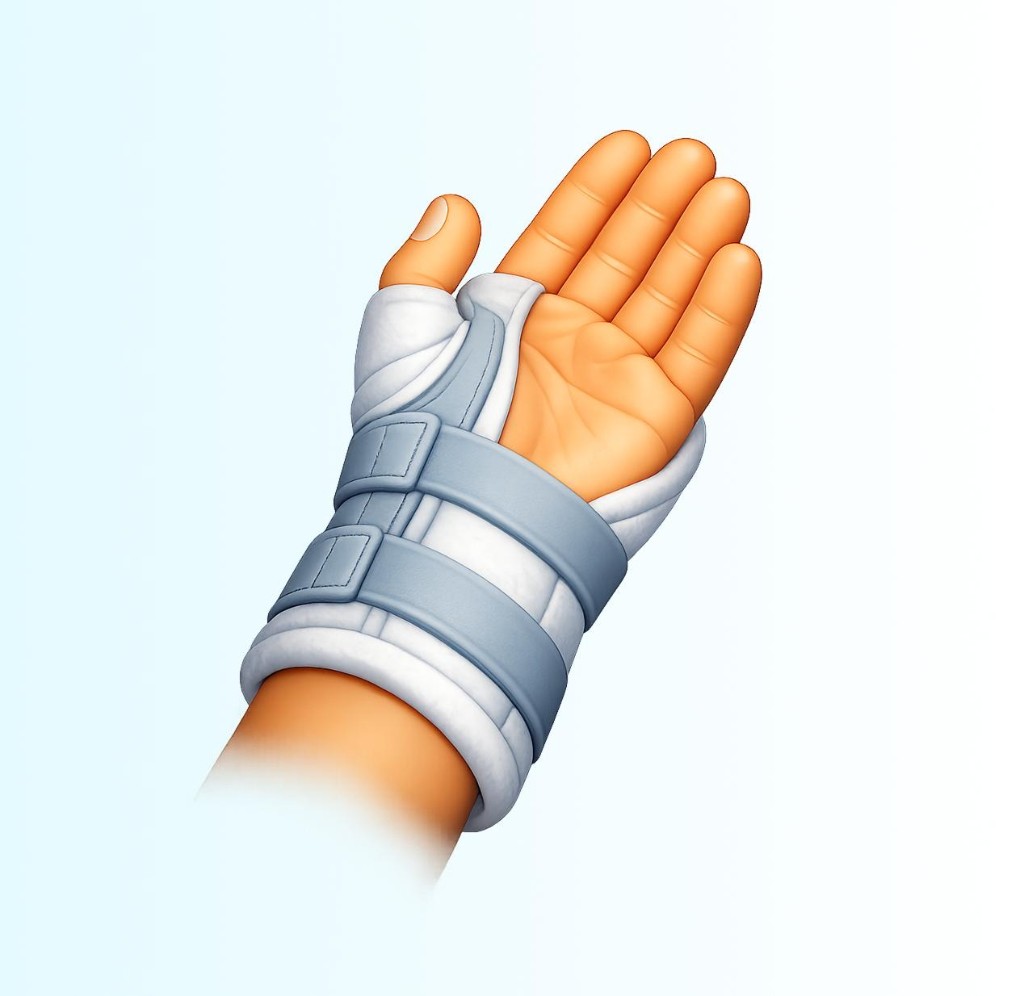
Hand joints — how they move together
Each page has a simple diagram, a patient-friendly explanation, clinical notes in therapist mode, vetted external sources, and links to neighboring joints plus the broader anatomy library. Exercise copy links here automatically when it names a joint.
Back to anatomy primer or exercises.
Interactive hand map
Hover or focus a region for a quick preview, then open the full joint page. On phones, highlights sit above a stacked preview card.
Interactive atlas
Hover or focus a highlight to preview. Tap opens the full joint guide.
Move over the hand diagram to see a quick summary of each joint region.
Major joint families
Broad categories that match how therapists and anatomy primers name groups of joints.
Wrist joint
The wrist is where the forearm meets the hand. It is a cluster of small bones and ligaments that lets you bend, extend, and tilt the hand while transferring force from the arm to the fingers.
Open guideThumb CMC (saddle) joint
The thumb’s base joint is shaped like a saddle so the thumb can swing out, rotate, and meet the fingertips — the foundation of pinch and grip.
Open guideThumb MCP joint
The thumb’s knuckle where the long thumb bone meets the first thumb segment. It flexes and extends and works with the CMC for pinch arcs.
Open guideThumb IP joint
The hinge at the end of the thumb (only one “finger” joint past the knuckle). It curls and straightens for fine pinch and key pinch.
Open guideMCP joints (knuckles)
The big knuckles where each finger meets the palm bones. They spread, curl, and help form the roof of the hand for grip and cupping.
Open guidePIP joints (middle joints)
The middle hinge of each finger (except the thumb). It bends a lot in daily tasks and is often where stiffness shows up first after injury or swelling.
Open guideDIP joints (tip joints)
The small hinge near the fingertip. It fine-tunes pad contact for typing, buttons, and pinch, and shares tendons with the middle joint.
Open guide
Browse by finger or thumb
Ray-level overviews that link into MCP, PIP, and DIP pages for that digit.
Thumb digit (ray) — overview
The thumb has three main levels: the saddle joint at the base, the knuckle (MCP), and the end hinge (IP). Together they let the thumb oppose the fingers for power and fine pinch.
Open guideIndex finger — joint overview
The index finger (second digit) is the pillar for pinch with the thumb and for pointing. It has three hinges: MCP at the knuckle, PIP in the middle, and DIP near the tip.
Open guideMiddle finger — joint overview
The middle finger is the longest digit and often takes the center of the grip span. Like the other fingers it has MCP, PIP, and DIP joints that stack motion for reach and power.
Open guideRing finger — joint overview
The ring finger shares tendons and muscle connections with the small finger side of the hand. Its MCP, PIP, and DIP joints follow the same hinge pattern as the index and middle fingers.
Open guideSmall (pinky) finger — joint overview
The small finger anchors the ulnar side of the hand for cupping and grip control. Its MCP, PIP, and DIP joints add the last segment of the power arc.
Open guide
Digit + level pages
SEO-friendly detail for each ray and hinge (for example index PIP vs ring MCP), each cross-linked to its parent category.